
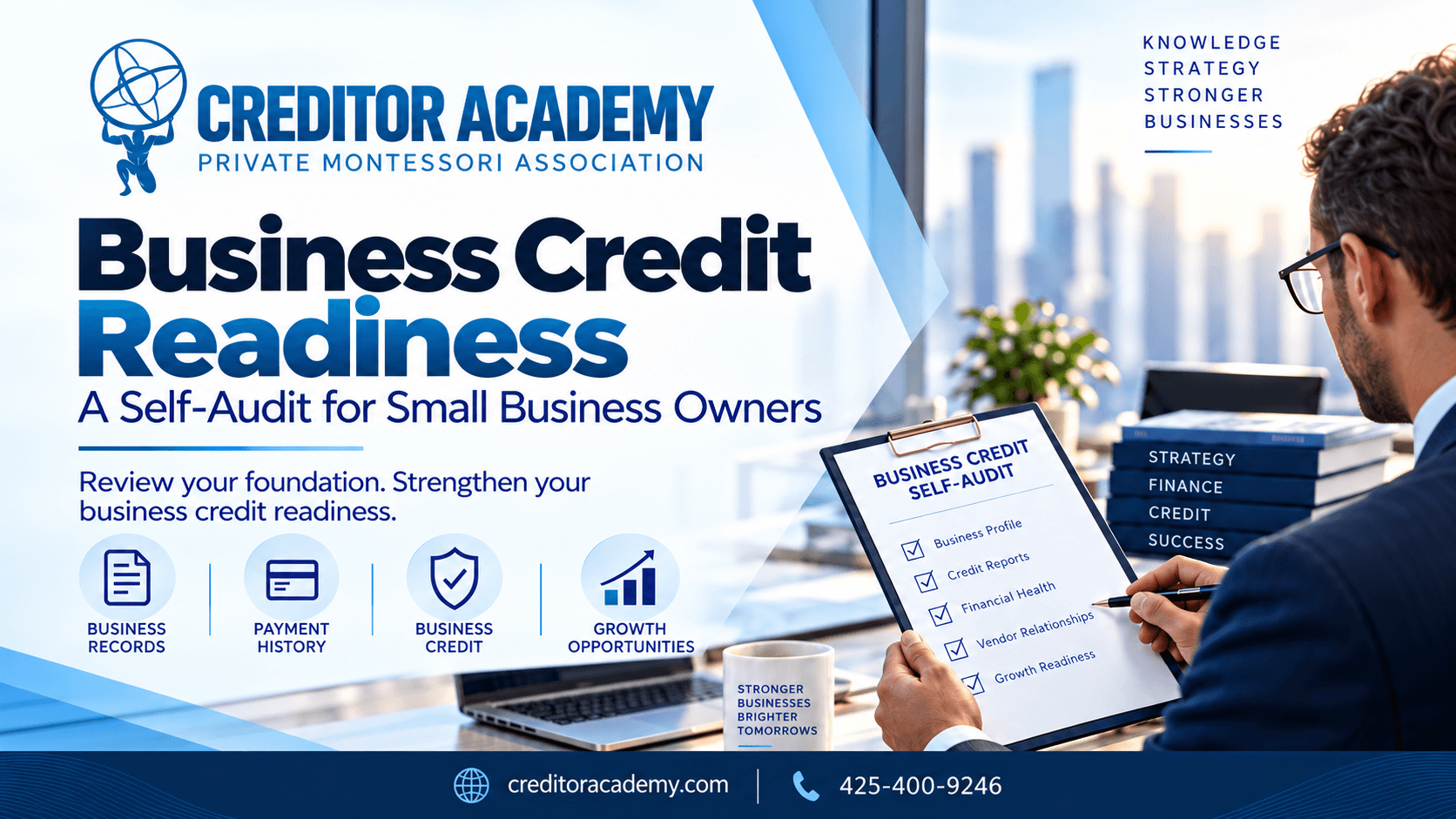
Before you apply for business credit, take a step back. A lender, supplier, payment provider, or business credit bureau may review different parts of your company information. If your legal details are inconsistent, your website is incomplete, or your financial records are difficult to locate, the process can become slower and more confusing than necessary.
This business credit readiness self-audit gives small business owners a practical way to review their current position. You will look at business identity, operational systems, financial records, payment processing, and available commercial credit information before deciding what to do next.
The goal is not to check every box just for the sake of checking boxes. The goal is to understand which items are relevant to your specific objective — such as supplier payment terms, a business credit card, a line of credit, or broader business credit preparation.
Important: This article is for general educational purposes. A self-audit is not a lender qualification test, legal advice, tax advice, or a guarantee of credit approval, funding, or a business credit score.
What Is Business Credit Readiness?
Business credit readiness is the process of reviewing how prepared your company is to pursue a specific commercial credit or supplier goal. It is not a universal pass-or-fail standard. Different lenders, vendors, payment providers, and credit reporting organizations may use different requirements and data sources.
Depending on your objective, business credit preparation may include reviewing your legal business name, address, phone number, email, and ownership information; your business structure and supporting formation documents; your business website, customer-facing policies, and online presence; your business bank account and financial recordkeeping process; your merchant processing setup and transaction history; your commercial credit profile and information held by relevant providers; and supplier, lender, or payment-provider requirements that apply to your situation.
A company seeking supplier payment terms may need to focus on different items than a company applying for a term loan. Start by defining the goal, then review only the areas that support that goal.
Why Run a Business Credit Self-Audit?
A short review can help you identify information gaps before they create delays. It can also help you make more informed decisions about which records to update, which providers to contact, and which services may or may not fit your business.
1. Find missing or outdated business information — Addresses, phone numbers, ownership details, and operating information can change over time. Comparing your records across formation documents, bank records, your website, invoices, and provider accounts can reveal inconsistencies that need attention.
2. Improve operational organization — A clear website, professional contact information, reliable payment processes, and organized records support day-to-day business operations. They may also make it easier to respond when a provider requests routine documentation. These practices do not guarantee approval.
3. Understand your current business credit position — If your company has a commercial credit profile, reviewing the available information may help you identify errors, missing trade activity, or items that deserve further investigation. Not every business has a profile with every bureau, and not every supplier reports payment history.
4. Make better decisions before spending money — A self-audit can help you decide whether to update your records, research reporting suppliers, improve your website, speak with a qualified professional, or wait until you better understand a product's requirements and costs.
Business Credit Readiness Checklist
For each statement, mark one answer: Yes (this is in place and has been checked recently), Partly (some work is complete, but gaps remain), No (this has not been completed or needs attention), or Not applicable (this does not relate to my current business goal).
1. Business Identity and Documentation - My legal business name is consistent across formation documents, bank records, invoices, contracts, and provider accounts. - My business address, phone number, and email are current and consistent wherever they appear. - I know which business structure applies to my company and where to find the relevant documentation. - I can provide formation, ownership, tax, or authorization documents if a provider requests them. - I have reviewed whether a business identifier, such as a D-U-N-S Number, is relevant to my specific objective.
2. Business Website and Online Presence - My website clearly states what my business does and who it serves. - My website includes accurate contact information and a working way for customers to reach me. - Important pages and links work correctly on both desktop and mobile devices. - My privacy, refund, shipping, and terms information accurately reflects my actual practices, where applicable. - My business name and contact details match the information used on other important business profiles.
3. Banking, Payments, and Merchant Processing - I use a business bank account appropriate for my company's operations. - I understand my payment provider's fees, settlement timing, reserve terms, and dispute process. - My merchant processing account uses accurate business information. - I keep records of sales, refunds, chargebacks, and payment settlements. - I understand that merchant processing does not automatically build business credit; reporting depends on separate arrangements.
4. Financial Recordkeeping - I track business income and expenses separately from personal transactions. - My invoices, receipts, contracts, and payment obligations are organized and accessible. - I know my recurring expenses, outstanding obligations, and expected cash flow. - My bookkeeping records are current enough to support routine business decisions. - I know when to seek help from a qualified accountant, bookkeeper, or financial professional.
5. Business Credit Profile and Preparation - I know which business credit bureaus or information providers may be relevant to my goal. - I have checked whether commercial information exists for my business, where appropriate. - I know how to dispute inaccurate information through the relevant provider's process. - I have confirmed whether suppliers or vendors report payment activity before relying on that activity to build history. - I have identified the requirements of the specific lender, supplier, or financing product I am considering.
How to Interpret Your Self-Audit Results
Your number of answers is not a credit score and does not create an official readiness rating. Use the results to identify the gaps most closely connected to your current objective.
If you have gaps in business identity questions — Confirm your legal name, contact information, operating address, and relevant documentation. If records conflict, determine which organization needs an update and follow its official correction process. If you are unsure about your legal structure or responsibilities, consult a qualified professional familiar with your jurisdiction.
If you have gaps in website or payment questions — Review the customer journey from a visitor's perspective. Fix broken links, make contact details easy to find, and ensure your policies match your actual business practices. For online payments, review provider requirements, costs, settlement timing, reserves, and dispute procedures.
If you have gaps in financial recordkeeping questions — Start by organizing income, expenses, invoices, receipts, contracts, and payment obligations. Accounting software or support from a qualified bookkeeper may help, depending on the size and complexity of your business.
If you have gaps in business credit questions — Learn which credit bureaus and commercial information providers matter to your goal. If a profile exists, review the information and use the provider's official process to address errors. Do not assume that obtaining an identifier or opening a merchant account automatically creates business credit history.
How This Audit Connects to Creditor Academy's 3-Step Framework
Creditor Academy's educational framework groups business credit preparation into three broad areas. Use these categories as learning topics, not as universal legal or financial requirements.
Step 1: [Become Private](/services/course-cataloges/become-private) — Build your understanding of business structure, ownership, responsibilities, and relevant documentation. The appropriate structure depends on your business and applicable law.
Step 2: [Operate Private](/services/course-cataloges/operate-private) — Review the practical systems that support your actual operations, including your website, payment services, customer processes, and recordkeeping. Those systems should accurately reflect your business and meet applicable provider requirements.
Step 3: [Financial Freedom](/services/course-cataloges/financial-freedom) — Learn how commercial credit information, supplier reporting, and lender requirements may affect business relationships. Different organizations may use different data and assessment methods.
Ready to Take the Next Step?
5 Practical Actions to Take After the Audit
1. Choose one main objective — Decide whether you are preparing for supplier terms, reviewing your business credit profile, exploring financing, or improving general business organization.
2. Prioritize the gaps that affect that objective — Start with inaccurate business information, missing records, or operational issues that a specific provider may review.
3. Create a document folder — Keep formation records, invoices, financial statements, contracts, provider details, and correspondence organized and current.
4. Research the requirements directly — Contact the relevant supplier, credit bureau, payment provider, or lender and ask what information it actually uses.
5. Repeat the review when your business changes — Revisit the checklist after a move, ownership change, new payment setup, major financial change, or before approaching a new commercial partner.
You do not need to purchase a service or make a structural change simply because an item appears on a checklist. First confirm that the action is relevant, lawful, and appropriate for your circumstances.
Ready to Take the Next Step?
Conclusion
Business credit readiness starts with understanding where your company stands today. Before seeking supplier terms, financing, or other commercial opportunities, review your business identity, website, payment systems, financial records, and available credit information.
Use this self-audit to prioritize the gaps that matter most to your current goal. Accurate records, consistent business information, and direct research into provider requirements can help you prepare more effectively — without treating every checklist item as a universal rule.
Continue learning through Creditor Academy's three-step framework and review the current webinar resources to organize your next steps.
To know more, visit our website Creditor Academy.
Frequently Asked Questions
What is a business credit readiness self-audit?
It is a structured review of your business information, operations, financial records, payment systems, and relevant commercial credit information. It helps you identify what to investigate before pursuing a specific business goal.
Does completing the checklist guarantee business credit approval?
No. The checklist is an educational planning tool, not a lender assessment. Approval depends on the provider's requirements, your financial circumstances, your application, and other relevant factors.
Do I need a business trust to build business credit?
No universal rule requires a business trust before pursuing business credit. The right structure depends on your goals, business facts, and applicable law. Obtain qualified advice before changing your structure.
Does merchant processing build business credit?
Not automatically. Merchant processing allows a business to accept payments. Whether payment information is reported to a business credit bureau depends on separate reporting arrangements.
What is the role of Dun & Bradstreet?
Dun & Bradstreet provides business information and credit-related products. Business owners can review relevant information and learn how commercial data may be used in business relationships. Other organizations may use different sources and methods.
What is a D-U-N-S Number?
A D-U-N-S Number is a business identifier issued by Dun & Bradstreet. Whether obtaining one is useful depends on the requirements of the organization or opportunity you are pursuing. It does not, by itself, guarantee a business credit history or approval.
Should I apply for financing immediately after the audit?
Not necessarily. First identify the specific financing product's requirements, compare costs and terms, and address relevant gaps. A self-audit should support an informed decision, not pressure you into an application.
How often should I repeat the audit?
Review it whenever your business details, operations, financial circumstances, or goals change. It is also useful before approaching a new supplier, lender, payment provider, or credit information company.
Learn More With Creditor Academy
At Creditor Academy, entrepreneurs can explore educational resources covering business credit, asset protection, business funding, private business operations, and financial freedom.
- Become Private — Learn about private business concepts, organization, ownership, and financial education.
- Operate Private — Explore business operations, organization, financial management, and related concepts.
- Financial Freedom — Develop broader knowledge around business credit, funding, asset management, and financial planning.
Join the Creditor Academy Free Webinar to continue building your financial knowledge and organize your next steps.
This article is provided for general educational and informational purposes only. It is not legal, tax, financial, accounting, investment, credit, or business advice. Business credit reporting practices, financing requirements, and laws vary by jurisdiction, creditor, reporting agency, and individual circumstances. Consult appropriately qualified professionals before making financial or business decisions.