
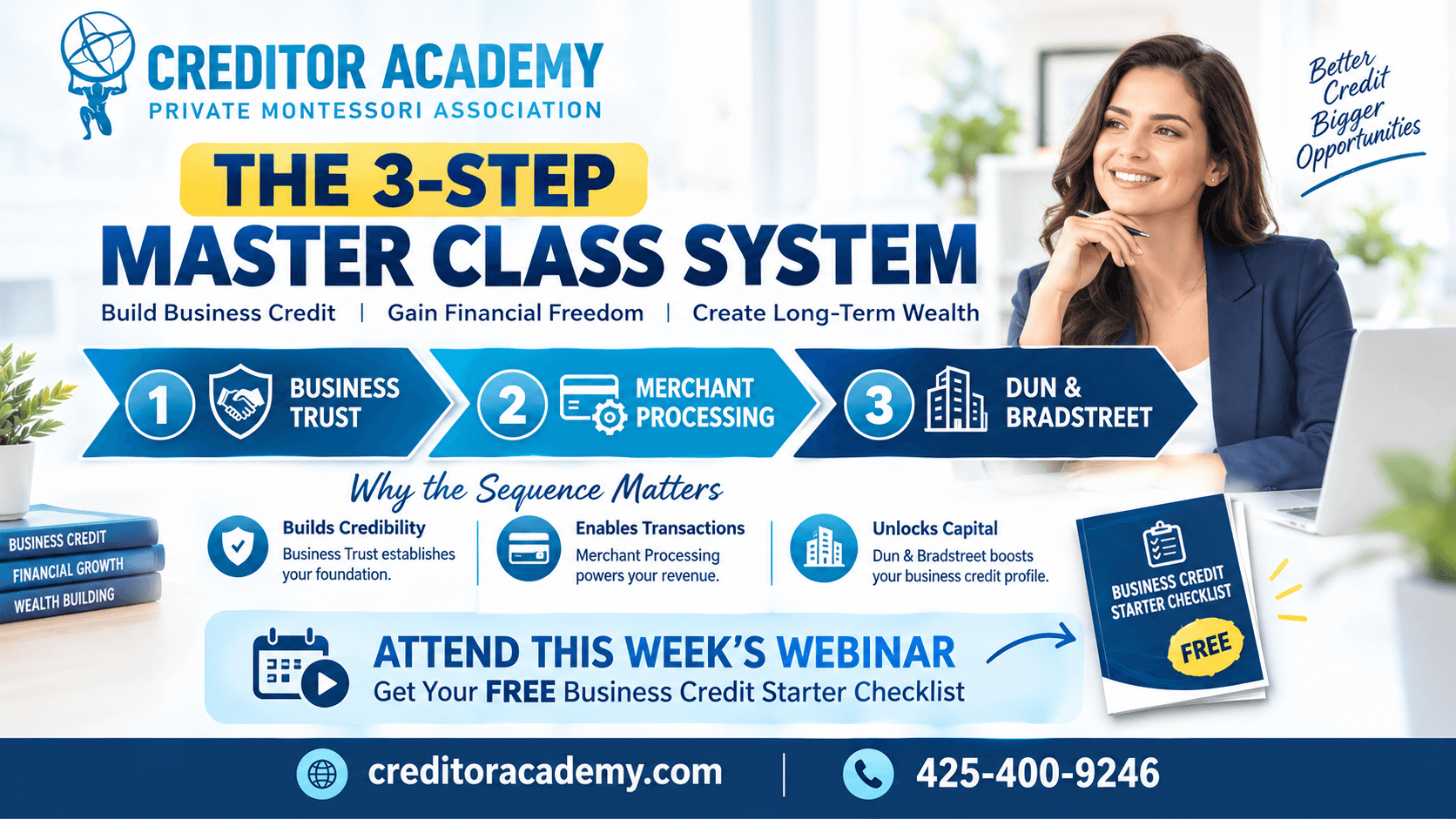
An educational guide to business structure, payment operations, and commercial credit information.
The three steps address three different business needs: ownership and planning, customer payments, and commercial credit information.
The Framework in One Sentence
Step 1 helps you understand how a trust may fit into ownership or estate planning. Step 2 explains how a business accepts and manages customer payments. Step 3 explains how Dun & Bradstreet identifies businesses and maintains commercial credit-related data.
What Is the 3-Step Master Class System?
The 3-Step Master Class System is an educational framework for understanding three parts of business preparation: business trusts, merchant processing, and Dun & Bradstreet. Each topic has a different purpose.
The sequence is not a universal legal or financial requirement. A business does not necessarily need a trust before opening a merchant account, and merchant processing is not a prerequisite for establishing a Dun & Bradstreet profile. The most useful order depends on the business's goals, structure, industry, and circumstances.
Step 1: Business Trust — Understand Ownership and Structure
A business trust is generally a trust arrangement used to hold or manage property or business interests under a trust agreement and applicable law. A trust commonly involves a grantor or settlor, a trustee, and beneficiaries.
The grantor establishes the trust and contributes property. The trustee manages trust property according to the trust instrument and applicable law. Beneficiaries are the people or organizations entitled to benefits under the trust terms. Exact roles and powers depend on the document and jurisdiction.
Why Entrepreneurs Study Business Trusts
Business owners may encounter trusts in ownership planning, succession planning, estate planning, and asset management. Understanding the structure helps an owner ask practical questions: Who owns the business interest? Who can manage it? How will it be transferred? What records are required? What tax, fiduciary, and legal consequences could follow?
A trust may be appropriate for one objective and unnecessary for another. A trust is not automatically a replacement for an LLC or corporation, and it does not automatically remove liability, eliminate taxes, protect every asset, or guarantee privacy from lawful reporting.
Key takeaway — Business Trust: Understand the purpose, responsibilities, costs, and limitations of a trust before creating one, transferring assets into it, or relying on it for business protection.
Learn more in Business Trust Explained.
Step 2: Merchant Processing — Understand Customer Payments
Merchant processing refers to the systems and services that allow a business to accept and process customer payments, especially credit and debit card transactions. The process may involve a customer, payment gateway or point-of-sale system, processor, acquiring bank, issuing bank, authorization, and settlement.
When a customer pays by card, the payment system helps authorize the transaction, communicate between the relevant financial institutions, and settle funds to the business. The business may also have to manage refunds, disputes, chargebacks, reserves, fraud controls, and reconciliation.
What to Evaluate Before Choosing a Provider
- Which payment methods customers prefer and which the business actually needs
- Transaction fees, monthly fees, reserve terms, and settlement timing
- Refund, cancellation, and chargeback policies
- Fraud prevention, account security, and customer support
- Integration with the website, point-of-sale system, and accounting software
- Industry-specific underwriting requirements and any restricted or higher-risk activity rules
A provider may review the business identity, ownership, products or services, expected transaction volume, transaction history, and risk profile. A clear website can help explain the business, but a website does not guarantee merchant approval.
Does Merchant Processing Build Business Credit?
Ready to Take the Next Step?
Not automatically. Merchant processing helps a business collect revenue and maintain transaction records. It does not guarantee that payment activity will be reported to a business credit bureau or improve a business credit score. Payment operations and credit reporting are different activities.
Key takeaway — Merchant Processing: Choose a payment system based on customer needs, provider terms, security, cost, support, and operational fit. Do not assume that having a merchant account automatically creates business credit.
Step 3: Dun & Bradstreet — Understand Commercial Credit Information
Dun & Bradstreet, commonly called D&B, is a business data and analytics company that provides business information and credit-related products. Businesses may encounter D&B when researching commercial credit profiles, supplier relationships, and creditworthiness.
One well-known identifier is the D-U-N-S Number, a unique nine-digit identifier used to identify businesses in the D&B system. A D-U-N-S Number is an identifier — not a credit score — and obtaining one does not automatically create a strong credit history.
How Business Owners Can Prepare
- Verify that the legal business name, address, and identifying details are accurate and consistent.
- Check whether the business already has a D&B profile or identifier and review the available information.
- Maintain responsible payment practices and pay suppliers or creditors according to agreed terms.
- Ask suppliers whether they report payment experiences and which commercial credit bureaus they use.
- Monitor available business information and correct genuine inaccuracies through the appropriate channels.
Business credit development takes time. A profile or identifier alone does not guarantee funding approval, favorable terms, a particular credit score, or a line of credit. Lenders and suppliers may use different evaluation methods and may also consider revenue, cash flow, time in business, debt, collateral, owner credit, or personal guarantees.
Key takeaway — Dun & Bradstreet: Accurate business information and responsible payment practices are useful parts of credit preparation, but a D-U-N-S Number is not a promise of financing.
Learn more about how business credit works.
How the Three Areas Fit Together
The value of the framework is that it separates three ideas that are often confused. A trust relates to ownership and asset management. Merchant processing relates to collecting customer payments. Dun & Bradstreet relates to business information and commercial credit data.
| Step | Main purpose | What to understand |
|---|---|---|
| 1. Business Trust | Ownership and planning | Whether a trust serves a genuine legal, estate, or succession objective; roles, duties, costs, and limitations. |
| 2. Merchant Processing | Customer payments | How the business accepts payments, manages fees, handles refunds and chargebacks, and records transactions. |
| 3. Dun & Bradstreet | Business information and credit | How business identity and payment experiences may be recorded and used by some suppliers or lenders. |
Common Mistakes to Avoid
- Assuming a business trust is required before building business credit.
- Confusing a merchant account with a business credit-reporting account.
- Assuming a D-U-N-S Number is the same as a credit score.
- Using inconsistent legal names, addresses, or ownership information.
- Relying on CPNs, fake identities, fabricated tradelines, or false applications.
- Expecting an EIN, trust, merchant account, or D-U-N-S Number to guarantee funding.
- Believing that any structure automatically eliminates taxes, liability, or reporting duties.
A Practical Next Step for Business Owners
Start by identifying which of the three areas your business needs to understand first. If the question is ownership or succession, speak with a qualified attorney and tax professional about whether a trust is appropriate. If the question is customer payments, compare merchant providers using written terms and a realistic view of fees and risk. If the question is commercial credit, verify business information, use real accounts for genuine business needs, pay on time, and monitor available reports.
Attend this week's Creditor Academy webinar and get the free Business Credit Starter Checklist. You can also explore Become Private, Operate Private, and Financial Freedom, or call 425-400-9246.
Ready to Take the Next Step?
Conclusion
The 3-Step Master Class System is a way to learn — not a guarantee. Business trusts, merchant processing, and Dun & Bradstreet each serve different purposes. Understanding those differences helps entrepreneurs make better-informed decisions and avoid expensive misconceptions.
This article is educational content, not legal, tax, accounting, investment, credit-repair, or financial advice. Trust law, entity law, payment-provider rules, commercial reporting practices, and tax treatment vary by facts and jurisdiction. Consult an appropriately qualified professional before creating a trust, transferring assets, applying for credit, selecting a payment provider, or relying on a tax or legal strategy.